
If global warming is real, how could there still be record cold days? And how did the eastern United States experience a record cold snap in 2012-13? Surely there would be no such records in a warming climate.
Fact:
Global warming doesn’t mean there are no very cold days, just fewer of them. Weather reports in the US and Australia over the last 60 years show that the number of hot and cold records were about equal during the 1950s, 60s and 70s. Then the number of heat records started to increase and the number of cold records started to fall. Today, there are now almost twice as many hot records as cold ones.
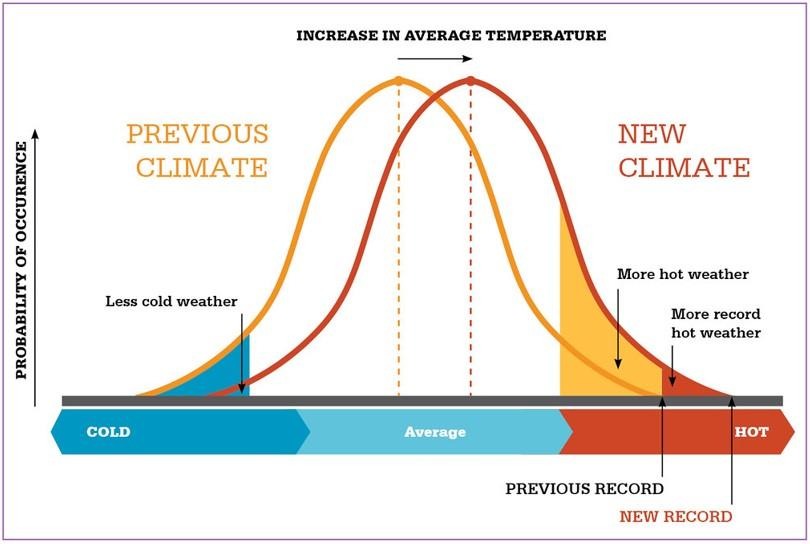
Extreme weather bell curve [Source: Climate Commission]
As for the record US cold snap in 2012-13, it was caused by changes in the Earth’s climate. Temperature increases in the Arctic have been causing movements in the jet stream – the band of strong winds near the top of the troposphere, about 10 km above the Earth’s surface. The jet stream acts like a barrier to the southward movement of frigid arctic air. In 2012, the jet stream moved south in a wave-like formation (known as the Wavy Jet Stream), taking cold Arctic weather with it. This is what produced the cold snap in the eastern US. At the same time, the western US experienced a terrible drought.