
The Earth’s atmosphere is becoming ‘carbon-saturated’, meaning that as the level of CO2 increases, its impact on global temperature will decrease. (In mathematics, this is known as the ‘logarithmic effect’.) As a result, we can happily go on emitting CO2 without causing significant increases in temperature.
Fact:
This view has been propounded by two of the most famous sceptics in the scientific community – Professor William van Wijngaarden and Professor William Happer. They claim that a doubling of CO2 levels from 400 ppm to 800 ppm will only increase global temperatures by 1°C. [We are currently at 427 ppm, up from 270 ppm prior to the industrial revolution.] To get an additional 1°C warming, CO2 would have to increase to 1,600 ppm, according to Wijngaarden and Happer.
It would be nice to believe that the Earth has a built-in stabiliser to save us from catastrophic climate change. However, the science doesn’t bear that out. Although it is true that the warming impact of CO2 decreases as its prevalence in the atmosphere increases, this effect is nowhere near as strong as Wijngaarden and Happer claim. The main reason for this is that as the concentration of CO2 increases, there is a corresponding reduction in the capacity of the Earth’s carbon sinks (mainly its forests and oceans) to absorb CO2. This means that more of our emissions finish up in the atmosphere than would otherwise have been the case. Another reason is that higher concentrations of CO2 result in feedback effects that increase global temperature. These include a reduction in snow and ice cover (which reduce albedo) and the melting of permafrost (which increases CO2 and methane emissions).
So no, ‘carbon saturation’ will not save us from ourselves.
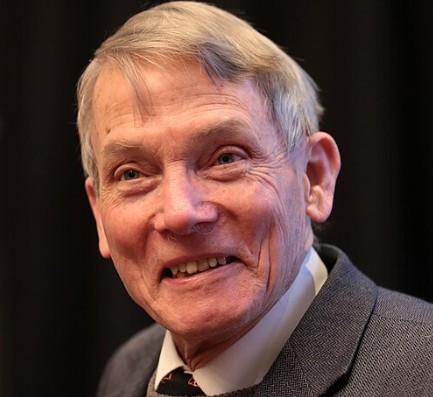
Professor William Happer [Wikimedia Commons]