
China is responsible for a third of global greenhouse gas emissions, yet it is doing nothing to get these emissions under control. There is no point other nations taking action until China does the same.
Fact:
While it is true that China is currently the world’s largest emitter of CO2 and is responsible for 32 percent of the world’s annual total, on a per capita basis the nation is not a huge emitter. The emissions of the average American are double those of the average Chinese and almost nine times those of the average Indian. So, it is quite disingenuous to single out China as the main culprit when it comes to global warming.
Secondly, it is not true that China is doing nothing about climate change. In September 2020, President Xi Jinping announced that the country would reach peak emissions by 2030 and net zero emissions by 2060. In fact, the country is way ahead of schedule, with peak emissions reached in March 2024 and total emissions falling by 1.6 percent during that year. If this trend continues, China will reach net zero by 2054 – well ahead of many other nations.
The reason for this is not surprising. In 2022, the nation added 125 gigawatts of renewable energy to its grid. In 2023, the figure rose to 278GW, then to 357GW in 2024 and to 430GW in 2025. This has brought the total to 1,190GW over the last four years. To put this in context, the US managed to install just 45GW in 2024 and 30GW last year. China also had 215 gigawatt hours of battery storage in 2025 – two and a half times that of the United states – with this figure expected to rise to 720GWh by the end of 2027. By the middle of 2026, Australia had 17.5GWh of battery storage.
All this means that China’s grid is now 42 percent renewable – about the same as Australia’s – and the electrification trend shows no signs of slowing down. By the end of 2025, the nation had electrified 76 percent of its rail network, 98 percent of its buses, 99 percent of its two-wheelers and 12 percent of its passenger vehicle fleet. Indeed, 58 percent of all cars purchased were EVs (up from 4.8 percent in 2019), with EV sales expected to reach almost 100 percent in the next few years. In addition, 28 percent of all heavy-duty trucks sold were fully-electric in 2025 – up from just 9 percent the previous year – and the number is expected to reach 60 percent by the end of 2026! The nation has 9,000 public charging stations dedicated to heavy-duty electric trucks, and another 21 million charge points devoted to EVs in general.
China is also taking other steps to reduce its emissions. In June 2021, it introduced an emissions trading scheme (ETS) to punish companies emitting CO2, and to encourage a shift to renewables. This priced emissions at US$6.30 a tonne and rose to US$10 in 2025. [By contrast, California’s ETS prices emissions at US$17 a tonne, while the EU’s scheme does so at US$98 a tonne (up from US$5.50 in 2017). Julia Gillard’s carbon tax, which Tony Abbott said would destroy the Australian economy, was US$20 (A$24) a tonne.] The Chinese ETS is already the biggest in the world, but will need to be ramped up considerably if the nation is to reach zero net emissions by the middle of the century.
Despite all of these initiatives, it is true that China is still building coal-fired power stations, but these will likely only be used as backups, to avoid a repetition of the power shortages that occurred in 2021-22. (These were the result of a severe drought that reduced the nation’s hydroelectric output.) Those coming online now also represent decisions that were made between five and seven years ago, before China fully committed itself to renewables. In fact, coal is in steep decline in China, falling at a rate of 2 percentage points a year. In the first half of 2025, its use fell by 3.4 percent. That year it was responsible for only 55 percent of the nation’s electricity generation, and China’s coal-fired power stations were operating at only 44.8 percent capacity. This is why coal use is going down, even though new plants are coming online. With gas representing 3 percent of the nation’s electrical generation use, renewables now make up 42 percent – and growing rapidly!
Besides doing its bit to stop climate change, China has other important reasons for reducing its carbon emissions. Foremost among these is the fact that its cities have been among the most polluted in the world, and the only way to reduce this pollution has been to stop burning coal and oil. In addition, many of its coastal cities are very low-lying and face inundation, even with relatively modest rises in sea levels. Similarly, its river systems are fed by glaciers that are threatened by warmer temperatures. Their loss would devastate the nation’s agriculture. The Chinese government is well aware of these problems.
Another reason to decarbonise is that China cannot aspire to superpower status while being dependent on fossil fuel imports, and it lacks sufficient domestic supplies to pursue a policy of fossil fuel autarchy. Were a war to come, the country would be vulnerable to a cut-off of oil, coal and gas supplies, and it does not have the military might or political will to defend far-off sea lanes. Decarbonisation is the only way it can achieve energy self-sufficiency.
Returning to the question of why Australia should take action on climate change even if other nations don’t, there are strong moral reasons for us to do so. The argument that we should do nothing is similar to that espoused by slave traders in the 18th century. If England were to withdraw from the slave trade, they asserted, other countries would simply fill the vacuum; no fewer slaves would be traded and England would deny itself an important source of income. William Wilberforce and the abolitionist movement, by contrast, argued that Britain had a moral obligation to act, irrespective of the cost. As it turned out, Britain’s decision to ban the slave trade shamed other nations into taking similar action. Within a dozen years of that decision, trade in human cargo was at an end. Slavery itself was abolished over subsequent decades.
Former British Prime Minister Boris Johnson put the moral argument about climate change very succinctly in 2020, when he said that it was incumbent on the countries that had put most of the CO2 into the atmosphere to act first to take it out. Under Johnson, Britain committed itself to net zero carbon emissions by 2050.
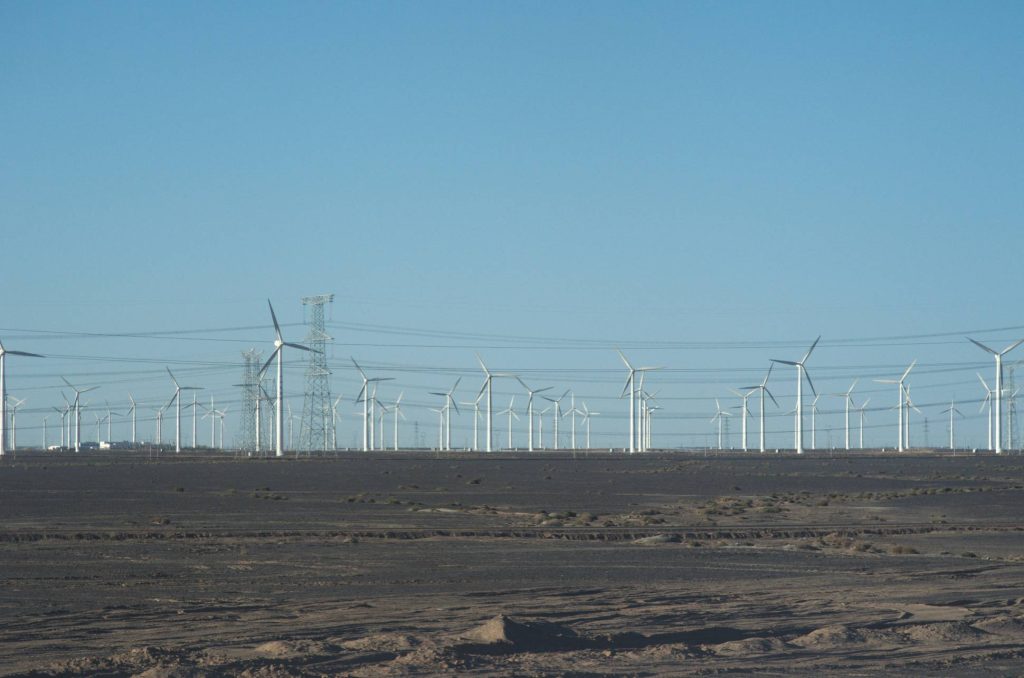
A wind farm in China [Source: Wikimedia Commons]