
You cannot power heavy industries like steel, aluminium and cement on renewable energy. They need coal, oil and gas.
Fact:
Some industries are indeed very difficult to decarbonise. They represent about 27 percent of global emissions. While replacement technologies are not currently available, replacement ones will be available over the next two decades.
Let’s start with steel. Several European companies have announced plans to produce low emissions versions of this vital building material. One is ArcelorMittal, the world’s second largest producer. It intends to make steel in its facility in Spain using hydro power. The Swedish power company Vattenfall plans to do something similar. Another Swedish company, HYBRIT, has supplied Volvo with the world’s first fossil-free steel. It intends to produce ‘green’ steel on an industrial scale as early as 2026. In Germany, ThyssenKrupp is committed to cutting emissions in its steelmaking operations by 30 percent by 2030, and by 100 percent by 2050.
As far as aluminium is concerned, the good news is that over 60 percent of the CO2 emitted when making it occurs when electricity is generated. By using renewable energy, all those emissions can be eliminated. Further reductions can be achieved by replacing the carbon anodes used in smelting with inert anodes that emit oxygen rather than CO2, and by using a process known as ‘mechanical vapor recompression’. Unfortunately, the remaining 18 percent of emissions cannot be eliminated, so will have to be sequestered using carbon capture and storage (CCS).
The real difficulty with decarbonising aluminium is not technology but cost. As yet, the necessary processes are too expensive to be commercially viable without government assistance. But that will change with time.
Cement is even more difficult and expensive to decarbonise than either steel or aluminium. One company that is seeking to do so is the Swiss conglomerate Lafargeholcim, the largest producer of concrete in the world. It has lowered its carbon emissions by 25 percent since 1990 and is pushing to reach net-zero emissions. Two other companies that have reduced their carbon footprint are China National Building Materials (the largest producer of cement in China) and CEMEX. The latter plans to reduce its carbon emissions by 35 percent by 2030.
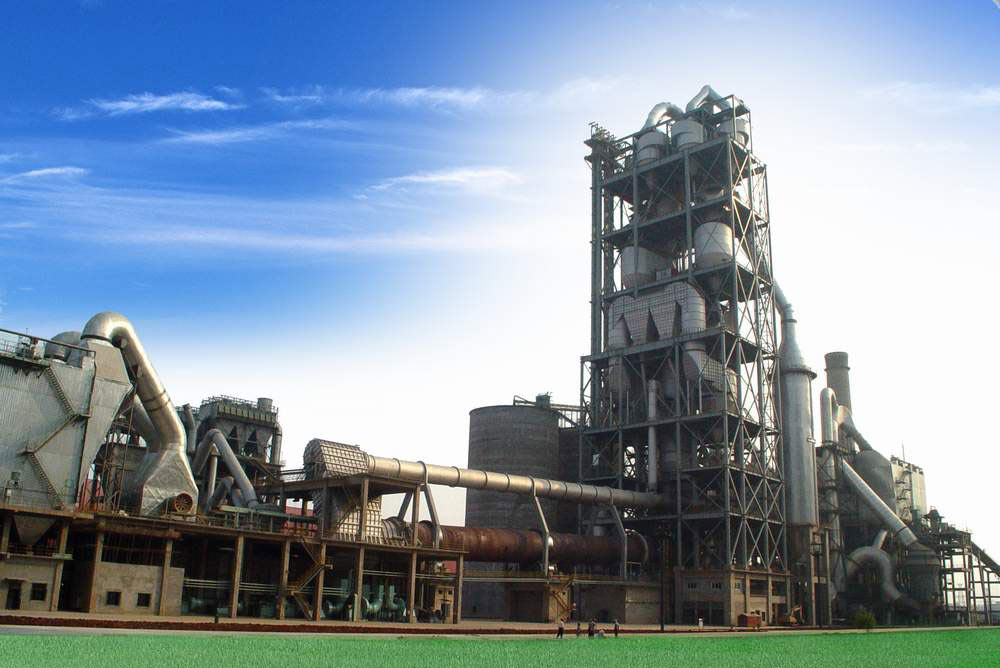
A cement plant [Source: Wikimedia Commons]
Until new technologies come along, the solution may be to find products that can replace cement altogether. Already, such a polymer has been produced from a combination of waste plastics and soil contaminated with hydrocarbons and heavy metals. If this polymer could be produced at commercial rates, it would allow emissions to be reduced and dangerous waste to be disposed of simultaneously.
So, it’s simply not true to say that some industries cannot be decarbonised. What is true is that they cannot be decarbonised yet or, at least, cannot be decarbonised at a price that is commercially viable. This means that while we wait for the situation to change, we must do everything we can to decarbonise the 73 percent of emissions that we can currently can.