
How has climate denial morphed over the past decade?
Dealing with climate denial is a bit like playing Whack-a-Mole. You knock down one variant, only to find another bobbing up in its place. That said, the nature of climate denial has fundamentally changed over the past few years. The climate movement is slowly winning the debate, but the very nature of the debate is changing. Climate sceptics are moving to safer ground, where they don’t have to challenge the science – not openly, at least – merely the solution proposed by those who wish to stop global warming.
First, let’s remind ourselves about the five different variants of climate denial. The first is the most fundamental: the refusal to believe that the atmosphere is heating up. The second accepts the reality of global warming, but not that greenhouse gas emissions are the cause. The third variant accepts the temperature record and may also accept the role played by greenhouse gases, but insists that a warming planet is essentially benign and may actually be good for us. The fourth variant is that the financial cost of stopping global warming is greater than the cost of adapting to it, so we’re better off opting for the latter. Finally, there is the doomsday variant, which says that it’s already too late to take action, so we’ll simply have to live with the consequences of our actions.
So, where are we at with regard to these five variants?
The positive news is that Variant One is in serious decline. According to a study by the Centre for Countering Digital Hate (CCDH), denial of the very existence of climate change accounted for 65 percent of all climate ‘sceptical’ stories on social media in 2018. Today, it represents just 30 percent of those stories. It would be even lower in the mainstram media, although no figures are provided in the CCDH study.
One reason for the change is that even the famous climate ‘sceptial’ scientists – men like Roy Spencer and John Christy, who spent 30 years denying the reality of global warming – have now accepted that the atmosphere has indeed heated up, and by the full amount asserted by the IPCC. It was impossible for them to go on saying otherwise, given the overwhelming amount of evidence to the contrary. For that reason, these men (they’re all men!) have disappeared from the media. Their message is no longer something climate scpetics want to hear.
What hasn’t disappeared is the evidence of climate change – the fires, floods, droughts and storms, and the constant reporting of new temperature records that have been set. People now know that global warming is real, and disregard the conspiracy theories being propagated by those at the fringes of the climate denial community. Those theories centre on the notion that the world’s meteorological agencies and universities are working together to falsify the temperature record. That is too ridiculous for rational people to accept – although more than a few irrational ones do.
This change in public opinion has forced mainstream sceptics to fall back on the other four variants of climate denial. A good example of this is One Nation senator Malcolm Roberts, who for years claimed that the temperature record was wrong – faslified by NASA and other global scientific institutions. Now he is tacitly accepting that the Earth is indeed warming, but inists that this warming is unrelated to greenhouse gas emissions.
The problem for Roberts and others who have changed gears is that Variant Two does not provide an alternative explanation for the warming they now tacitly accept. A decade ago, sceptics thought they had the answer: the temperature increase was caused by greater activity on the surface of the sun. But that idea has been put to rest by the fact that solar activity has been on the decline for the last 20 years, while global warming has powered on unchecked. If solar activity really were the cause, then the Earth should have cooled not warmed. The sceptics seem to know this, as they are no longer blaming global warming on the sun.
But that hasn’t stopped them from promoting Variant Two. In fact, they are now arguing that the warming we are currently experiencing is just part of the Earth’s natural temperature cycle. That argument has some appeal, as the Earth does go through temperature cycles. But those cycles take place over tens of thousands of years, not decades as we’re seeing of late. In fact, the ‘natural’ rate of warming as the planet emerges from an ice age is on average 0.5°C every 750 years! We’ve experienced that in just the last 40! In other words, what is happening now is anything but natural.
Unfortunately for the sceptics, the public can see this, so they’ve had to move on to the third variant of climate denial: the notion that a hotter planet will actually be benign. The justification for this view is that crops grow faster when CO2 levels are higher, so a warmer planet will be a greener one too. As is often the case with misconceptions, there is some truth to this argument. Scientific experiments have shown that crops do indeed benefit from higher levels of CO2, but only if the ambient temperature remains constant. If the rise in CO2 is accompanied by a rise in temperature, then crop yields actually fall. In other words, in order to make the case for Variant Three, sceptics have to return to Variant One – that is, to deny the reality of global warming. And given that the public doesn’t accept Variant One, Variant Three falls apart too.
And so we get to Variant Four – the main argument used by sceptics today. This is the idea that climate solutions won’t work or are too expensive to implement. In the conservative media we are now seeing a relentless attack on renewable energy and electrification. The object is to sow doubt in people’s minds about the viability of solar, wind and battery storage to solve the problem of climate change. Supposedly, these will cost too much, cause people to lose their jobs and limit freedom of choice. A growing number of sceptics are even suggesting that renewables will be bad for the environment. Hence, we are hearing claims that onshore wind turbines kill birds and that offshore ones kill whales. Never mind that feral cats kill a thousand times more birds each year than wind turbines, or that ships actually do kill whales, climate sceptics are not concerned about actual threats to wildlife, only the ‘dangers’ of renewable energy.
So, what can we conclude from all of this?
Firstly, we have to accept that climate denial cannot be fought solely on scientific grounds. This is because climate sceptics are only interested in science when it valicates their preexisting ideas. When it doesn’t, the simply ignore it.
Secondly, climate denial is not rational. It’s possible for climate sceptics to accept two completely contradictory views at the same time. It doesn’t matter to them that they are contradictory, only that they provide a rationale for doing nothing about climate change.
Thirdly, we are never going to change the minds of hardline climate sceptics. Their views stem from deeply held beliefs that cannot be shifted. It’s therefore largely a waste of time even trying. Instead, we should be immunising the rest of the community against the misinformation they are spreading. That can be done using scientific, economic and environmental reasoning. Hence, when people hear the falsehoods contained in the five variants of climate denial, they recognise them for what they are and reject them outright.
So, although we now have climate denial on the run, we haven’t got it beaten. To do that, we need to keep up the attack until the views its proponents espouse are completely discredited. There is still a long way to go before that happens, but the fact that Variants One and Two have now been largely abandoned suggests that it’s only a matter of time. The problem is, we don’t have an infinite amount of time before climate change takes exacts a serious toll.
For more information on climate denial, check out Climate Myths and How to Respond to Them, which you can access here. It looks at over 120 misconceptions about climate change, renewable energy and EVs, and rebuts them in a way that is simple to understand.
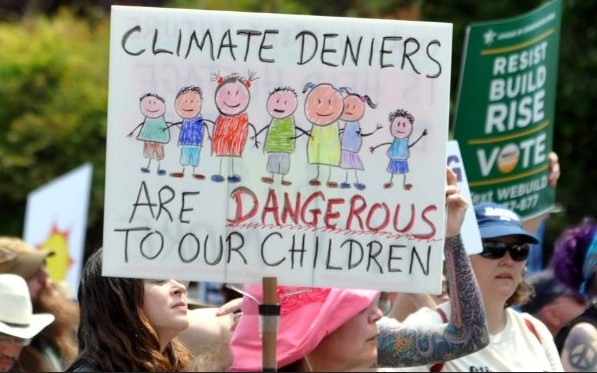
Some of the views espoused by climate sceptics. [Source: Wikimedia Commons]