
Where does Australia stand in comparison with other nations, and why has the rollout of wind stalled?
While Australia is a world leader in the rollout of solar and battery storage, it is also well advanced in terms of wind energy. Currently it ranks 12th in installed wind capacity, with a total of 15.4GW. The nation’s energy mix in 1999 and 2025 are shown in the table below. The transformation is evident.
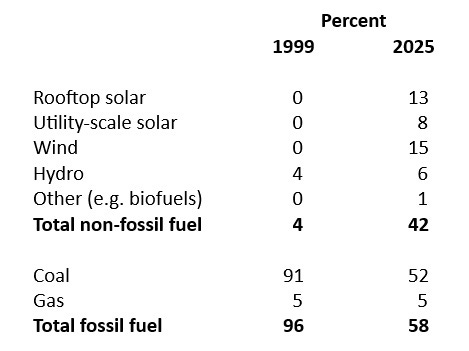
While renewables averaged 42 percent over the course of 2025, they reached 45 percent in the September quarter and 50 percent in the December quarter (which also covers the first month of 2026). Much of this is explained by the unusually good weather the nation experienced over that six month period, but also by the continued rollout of solar and the success of the government’s Cheaper Home Batteries scheme. The latter has resulted in the installation of 490,000 home batteries and added 7.8GW of storage to the grid by the middle of 2026. When this is added to the existing 3.6GW of home battery storage and the 6.5GW of big battery storage, the total becomes 17.9GW – fully a third of what is needed to decarbonise the grid. This increase in storage has significantly reducing the call on grid power in the early evenings and thereby pushed the share of renewables steadily higher. It’s a huge success story.
Unfortunately, the rollout of wind power has not been as successful as that of solar and batteries, and this is threatening to become a serious problem. In 2025, only 94 megawatts of wind capacity was added to the grid, compared with 7GW of solar. (One gigawatt is equal to 1,000 megawatts.) More alarmingly, no new wind projects have broken ground since December 2023. Yet for the grid to get to 82 percent renewable energy, we will need to install an additional 6,000 turbines, or 100 every month for a period of five years. We are nowhere near achieving this number.
There are a number of reasons why wind power is lagging so far behind solar and battery storage.
The first relates to the escalating cost of building wind farms. According to the CSIRO’s GenCost Report, costs in the sector rose by 8 percent in 2023-24 and 6 percent in 2024-25. This stands in marked contrast to the cost of solar, which has fallen by 8 percent every year for over a decade. This is because solar panels can be mass produced, thereby gaining economies of scale. They can also be transported easily and cheaply. Neither of these things applies to wind turbines – particularly the transportation issue. Turbines are mostly made in Europe and are expensive to transport all the way to Australia. In addition, the invasion of Ukraine in 2022 depriving the Europe nations of cheap Russian gas, forcing them to find alternative forms of energy. Wind was high on their agenda, pushing up the price of turbines. This made solar power a more attractive investment proposition than wind in Australia. Hence, the disparity in expenditure and installation.
A second problem holding back the development of wind power is the lengthy approval process projects have to go through. Onshore wind farms can take up to 8 years to be approved. Their offshore counterparts take even longer. Then there is the construction process. This can take between one and 3 years, meaning a project can take up to 11 years to pass from proposal to operation.
A third problem relates to transmission bottlenecks. Even when a project is completed, the transmission lines may not exist to connect it to the grid. This may be because of cost overruns, planning problems or construction difficulties. An example is the VNI West transmission line, which will link renewable energy zones in Victoria, South Australia and NSW. It was supposed to be completed by 2028, but will not be ready until 2030. Another example is the EnergyConnect link, which also hooks up the same three states. It was slated for completion in 2026, but will now not be ready till the end of 2027. Finally, there is the Marinus Link, which will connect Victoria and Tasmania. It has been delayed from 2030 to 2032.
A fourth problem relates to community opposition to wind farms in rural areas. Some residents are concerned about the environmental impact of wind turbines (e.g. their impact on bird populations). Others object to the so-called ‘visual pollution’ the turbines cause. Still others are angry that only farmers who actually host turbines get any financial benefit from them, while their neighbours suffer the supposed consequences. And, of course, there are the conspiracy theories, like the notion that wind turbines can make local residents sick.
Finally, there are politicians and media commentators who are implacably opposed to renewable energy, and who see community opposition as a way to stop projects from going ahead. Such views have long dominated One Nation and the National Party, but are now getting traction inside the Liberal Party.
Fortunately, not all the news is bad. The enormous success of the government’s Cheaper Home Batteries scheme, combined with the rollout of big batteries across the country, has compensated for some of the downturn in wind installation. These batteries can shift power produced in the day to the early evening, when demand spikes. This in turn has reduced the need for power generation after dark – something only wind can do, as far as renewables are concerned.
That said, it is imperative that investment in wind be boosted if we are to fully decarbonise the grid by the mid 2030s. This can only be done if governments reduce the time needed to approve projects, increase the level of financial support given to these projects (such as via the Capacity Investment Scheme) and speed up the construction of transmission lines.
At the same time, it is imperative that community and political hostility to wind farms be addressed. Polls show that a clear majority of Australians support the rollout of wind, including in areas where the farms themselves are being built. It’s only a minority that actually oppose them. But that minority is very vocal and has had a disproportionate amount of influence in both the media and the corridors of power. Supporters of renewable energy need to be equally vocal, if that influence is to be curbed. The success of Australia’s energy transition depends on it.
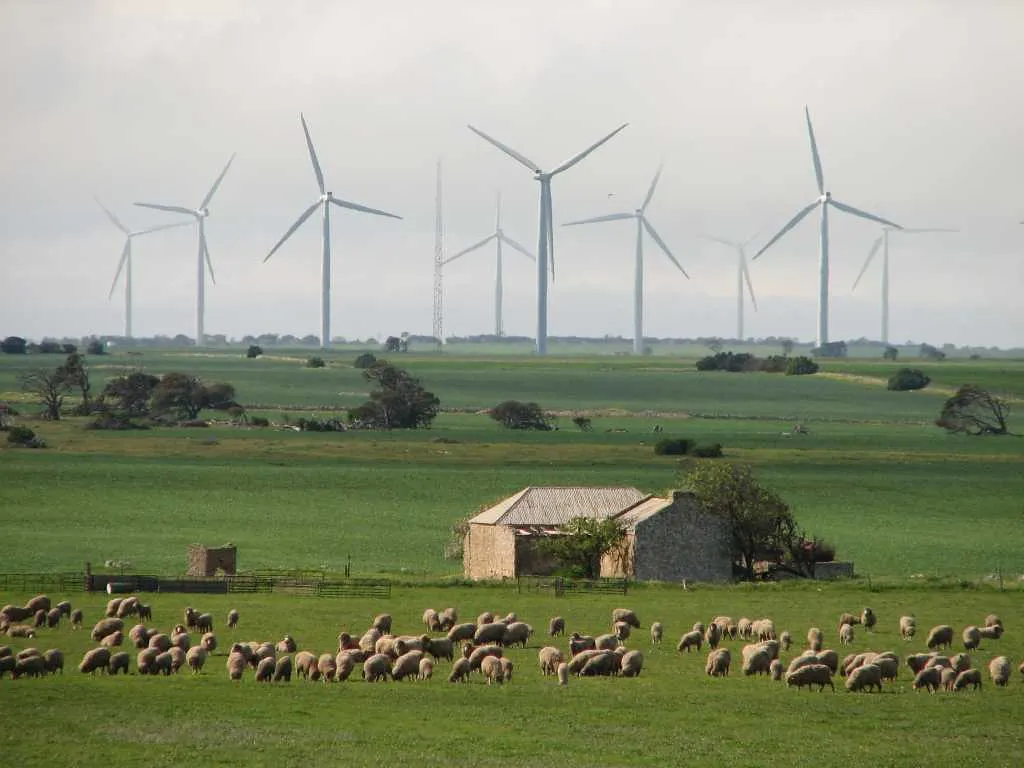
Wattle Point wind farm, which has been operating in South Australia since 2005.