As it turns out, a lot.
The tactics used by groups like Extinction Rebellion bring to mind the highly successful campaign run by a group calling itself BUGA-UP, back in 1980s’ Australia. BUGA-UP stood for Billboard Utilising Graffitists Against Unhealthy Promotions. The unhealthy promotions being targeted were cigarette ads, which were rife at the time. While the advertising of tobacco products on radio and television was banned in 1976, other types of promotion were still permitted. BUGA-UP realised that it could not stop cigarette companies from advertising in newspapers and magazines or from sponsoring sporting events, but billboards were sitting out in the open, ripe for attack.
Using spray paint cans, BUGA-UP’s activists cleverly changed the wording of these signs so they highlighted the dangers of smoking rather than the supposed attractions. One of the most commonplace ads at the time was for Winfield cigarettes. The brand was famously spruiked by Paul Hogan, using the slogan ‘Anyhow, have a Winfield’. By a bit of deft spraying, BUGU-UP activists could change this to ‘Man how I hate a Winfield!’ or ‘Anyhow, buga up a Winfield!’ or ‘New, vile and a bore!’. [See the photo below.]
The campaign captured the public’s imagination, and kickstarted government action to ban all advertising of tobacco products. By 1992 – just thirteen years after BUGA-UP’s formation – the battle was won.
So what can the climate movement learn from BUGA-UP’s activities?
One of the main reasons the campaign was so successful was that it combined guerrilla tactics with a razor sharp message. The tobacco companies were presented as purveyors of a dangerous product, and uncaring of the consequences of their actions. BUGA-UP’s activists, by contrast, were seen as heroic ‘Robin Hoods’, thumbing their noses at the rich and powerful corporations that were peddling death. The more the companies pressured the police to arrest the graffitists, the more the public sympathised with the latter – even though those activists were clearly breaking the law. People also saw the ‘crime’ of graffitiing billboards as inconveniencing only the companies themselves, so they didn’t care about the damage being done. Indeed, people used to enjoy seeing the clever slogans BUGA-UP devised, and were amazed at how quickly new signs got ‘doctored’. [Actually, many of these signs were literally ‘doctored’, as a number of medical practitioners were members of BUGA-UP. One of the organisation’s leaders was a thoracic surgeon.] BUGA-UP would even put out a yearbook, featuring the cleverest of its ‘artwork’ over the previous twelve months.
The other innovation used by BUGA-UP was to operate via independent ‘cells’, which had next to no communication with one another. A cell – usually just two or three people – would target a particular billboard and inform the organisers of BUGA-UP that they were taking responsibility for that sign. This could be done anonymously. They would then ‘doctor’ it at their leisure. If they were caught, they could not give evidence against BUGA-UP’s leaders, as the latter were not actually directing the campaign; it was totally decentralised. In addition, most activists did not even know who the leaders were.
The other great thing about BUGA-UP was that its actions were fun to carry out. Dodging the police in the name of a good cause had a romantic appeal to it, and like modern-day graffitists, BUGA-UP cell members loved admiring their own handiwork. Being a part of that campaign is something that still gives participants a sense of pride.
The climate movement shares many characteristics with BUGA-UP. In the first place, it is fighting a cabal of powerful companies that are hawking a det of dangerous products – in this case, coal, gas and oil. In addition, those companies have spent large sums of money trying to persuade people that their products are harmless. And also like the tobacco companies, they know full-well that this is untrue. Indeed some of the earliest work done on the impact of greenhouse gas emissions was by scientists working in the fossil fuel industry. Needless to say, their work was buried because it presented the companies with an inconvenient truth (to quote the words of former US vice-president Al Gore).
A big point of difference, however, is that the climate movement is up against an industry that still has considerable social license. Most people remain dependent on one or other type of fossil fuel, whether that be coal for electricity, gas for heating or oil for their car. So the industry can still claim to be performing an important social service.
Twenty years ago that was a powerful argument, as the world lacked a viable alternative to fossil fuels. But not anymore. Renewable energy can now replace all three sources of energy, for up to 75 percent of global economic activity – and at a price that is commercially viable. The other 25 percent will be replaceable within the next two decades – given the rate of technological change currently being experienced. We are in a perfect position to decarbonise the global economy without reducing our standard of living. The only thing standing in our way is the fossil fuel industry, which is determined to retain its business model for as long as possible.
The role of the climate movement is to chip away at the fossil fuel industry’s social license, the same way that BUGA-UP chipped away at the social license of the tobacco industry. This means reminding people that greenhouse gas emissions are pushing up global temperatures and threating a bleaker future for their children. It also means reminding them that we no longer need coal, gas and oil for most of the things we do. There are cleaner, cheaper alternatives available. Those wanting to block the rollout of such alternatives are doing so for their own selfish reasons – which is unacceptable to the broader society.
In its struggle against tobacco ads, BUGA-UP had the advantage of being on the right side of both science and history. The climate movement has this advantage too. In years to come, its activists will look back on the job they did with the same sense of pride that BUGA-UP activists do today, only this time it’ll be the planet they saved, not just the health of Australian smokers.
[Disclosure: The author, Ken Enderby, was an active member of BUGAUP in the 1980s. He and the others in his cell were responsible for doctoring a prominent billboard on the train line between Macdonaldtown station and Newtown station in Sydney. Living nearby, they would sneak out late at night, climb the fence giving access to the billboard, then start spraying. Ken’s role was to cup his hands into a foothold, so his ‘co-conspirator’ could reach high enough to alter the sign. A third member of the team acted as lookout, with a walkie-talkie in hand, in case the police decided to make an appearance. Mercifully, they never did, meaning Ken and his ‘cell’ mates never got to be ‘cellmates’ at the government’s pleasure!]
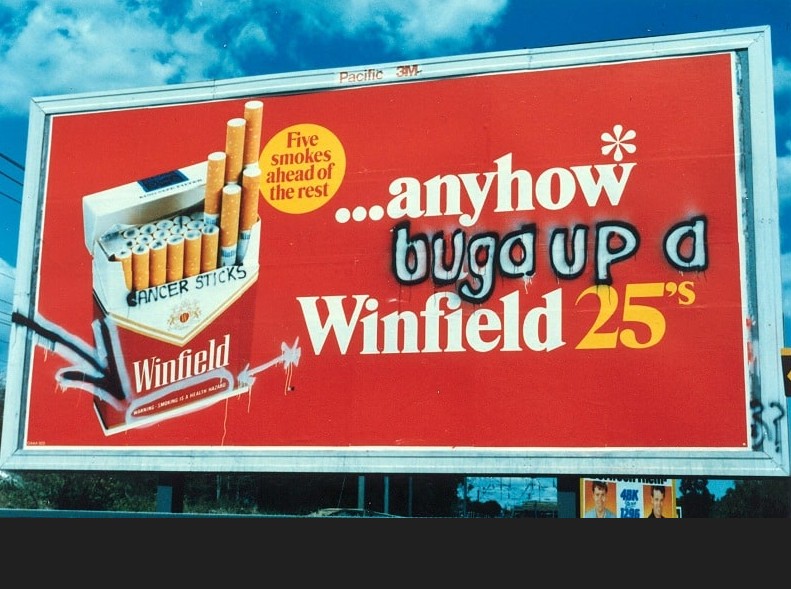
A sign doctored by BUGA-UP in the 1980s. [Source: The Commons Social Change Library]