What can climate activists learn from the anti-war movement in the United States in the 1960s and ‘70s?
Many movements for social change are divided between those who see revolution as the way forward and those who prefer evolution. In some cases, this translates into a debate over whether society’s basic structures need to be changed, or whether progress can be made within the existing system. In other cases, the conflict is over whether to use protest as the main form of attack or quieter methods like education and lobbying.
Protest has been a central part of most movements that have achieved social change. The Civil Rights movement in the United States is a prime example, as was the suffragettes’ campaign for voting rights in Britain. The Franklin River blockade is a great case study from Australia. But protest has not been the only way to bring about change. The Civil Rights Act of 1964 would not have been passed without the efforts of President Lyndon Johnson, who had to beg, bribe and cajole members of Congress to pass the legislation. [His predecessor, John Kennedy, had been unable to get it through during his presidency.] Similarly, the granting of suffrage rights in Britain was hastened by the role women played in World War I, when they worked in vital industries like munitions. And, of course, the Franklin River would not have been saved had Bob Hawke not been elected prime minister in 1983. In all three cases, protest highlighted an injustice and helped build a movement large enough to shift political opinion.
Thanks for reading! Subscribe for free to receive new posts and support my work.Subscribe
But excessive protest can sometimes be an impediment to social change. During the Vietnam War, the anti-war movement in the United States was divided between moderates, who wanted to end the war by supporting ‘peace’ candidates in the presidential race (like Bobby Kennedy and George McGovern), and radicals, who wanted to end it by making the nation ungovernable. Abbie Hoffman, the most prominent of the radicals, saw the war not as a foreign policy abberation, but as a symptom of American capitalism. He hoped to use the unrest generated by the war to bring the system down.
Sadly, some of the actions Hoffman and his supporters unleashed allowed the conservative media to portray the anti-war movement as violent and ‘un-American’. In particular, they organised a protest outside the Democtratic National Convention in 1968, which quickly turned violent. No one knows who started the violence, although it’s a good bet it was Chicago mayor Richard Daley, who sent 20,000 police to confront 5,000 protestors. Whatever the case, the media presented it as evidence that America had become ungovernable – the precise message the protesters hoped to convey. But the public did not react in the way the protesters hoped. In the 1968 election, Richard Nixon promised to restore law and order by cracking down on protest. The message resonated with enough people to secure him a narrow victory. [The Democratic Party’s ‘peace’ candidate, Bobby Kennedy, was assassinated during the primary campaign, leaving Vice President Hubert Humphrey as the party’s presidential candidate. Humphrey was seen as ‘tainted’, given his role in the Johnson administration.]
During the election campaign, Nixon promised to bring “peace with honour” in Vietnam. It was only afterwards that people discovered what this actually meant. The new president intended to fight on and win. Instead of de-escallating, he increased troop numbers, then dragged Cambodia and Laos into the conflict. Another two million people died as a result of those decisions.
It was actually a different form of protest that finally ended America’s involvement in Indochina. In 1971, former Pentagon analyst Daniel Ellsberg sent the New York Times and the Washington Post copies of the Defence Department’s secret history of the Vietnam War – a history the media dubbed The Pentagon Papers. It revealed the litany of lies successive presidents had told the public to justify involvement in the conflict. In particular, it revealed that at the very time the Johnson Administration was still talking about victory, it actually knew the war was unwinnable. Ellberg himself had given the government this advice, having spent two years in South Vietnam assessing why progress had halted. He had been one of the authors of The Pentagon Papers and in the process discovered that he too had been deceived. In the end, it was all too much, and he decided to take radical action to end the war. He spent months secretly photcopying the 10,000 page study, then sent it to senior members of Congress. When they refused to make it public, he sent it to the media. President Nixon tried to block its publication, but in the end the Supreme Court sided with the media. The whole dirty story became public, and the war became untenable. Nixon had no choice but to pull out.
Out of interest, Nixon had no intention of letting Ellsberg get away unpunished. He had him charged with releasing top secret documents – a crime that would have seen him face 115 years in prison, if convicted. Unlike Julian Assange, however, Ellsberg chose to face the charges head on, standing defiantly on the steps of the courthouse to declare that he was prepared to spend the rest of his life in jail if that’s what it took to end the war. This only enraged Nixon, who was determined to destroy Ellsberg’s reputation. To do this (and other things), he formed the infamous ‘Plumbers’ group and ordered them to break into Ellsberg’s psychiatrist’s office and steal his medical records. The hope was that leaking these records might convince the public that Ellsberg was crazy. When the break-in became public during the Watergate hearings, the judge presiding over Ellsberg’s case dismissed the charges, on the grounds that the latter’s rights had been infringed.
So, what lesson can the climate movement take from this? Clearly, there is an important place for protest, just as there is a central place for less confrontational forms of action. The key is to ensure that all protests have a positive impact on the national debate, not a negative one. The vast majority of the actions organised by the climate movement in Australia do indeed have a positive impact. These include marches, demonstrations, blockades, sit-ins, strikes, walk-outs and vigils. Even some illegal actions can have a positive impact if they target only the ‘wrongdoers’. A very successful example was BUGA-UP’s campaign against tobacco ads in the 1980s. The organisation targetted billboards with cigarette advertisements – not defacing them, but altering them so they had a humorous message. This turned the ads against the tobacco companies rather than for tobacco. BUGA-UP’s activists were seen as modern day Robin Hoods fighting King John and his barons. [There is a separate Substack article on BUGA-UP’s campaign.]
That said, what counts as counterproductive action? The answer is anything that disrupts the public rather than the fossil fuel industry and its allies. Examples include painting slogans on public property (like ‘No war’ on the Sydney Opera House) or blocking traffic on busy thoroughfares. Such actions attract attention to the relevant cause, certainly, but at the cost of discrediting that cause. Even when the disruption is actually quite minor, it can be portrayed as much worse than it actually was. The net result is that people blame the activists rather than the actual villains.
Another problem can occur when activists let the perfect sabotage the possible. This was the case with Labor’s Emissions Trading Scheme (ETS), which was voted down by the Greens because it was seen as too weak to make any significant difference to Australia’s emissions. That decision, which was supported by large sections of the climate movement, set off the so-called ‘climate wars’, which have raged in Australia ever since. Had the ETS been passed by the Senate, it could have been ramped up over subsequent years until it became an effective weapon in the war against climate change. And the public wouldn’t even have been aware of its existence.
Then there is the problem of activists getting too far ahead of public opinion. They wind up demanding more of their politicians than voters can accept. A case in point was the Carbon Pricing Mechanism – the so-called ‘carbon tax’ – introduced by the Gillard government in 2012, as part of a deal with the Greens. The problem was that the government had no mandate to introduce such a scheme. In fact, the prime minister, Julia Gillard, has specifically campaigned against it, only to change her mind when she needed Green support in the Senate. Opposition leader Tony Abbott was able to wage a brutal campaign against the tax, arguing that it was not just a broken promise, but that it would also destroy the economy. While the latter claim was nonsense, the public was in a mood to listen. Abbott won the next election and repealed the tax. It put the climate movement back almost a decade – all because of overreach.
The problem for climate activists is that they are only trying to do what science says must be done if the planet is to be saved. But politics doesn’t work that way. It is a gradual process, that operates by building consensus. Australia’s nation health insurance scheme, Medicare, is a good example. First introduced by Labor in 1974 (under the name ‘Medibank’), it was repealed when the Coalition returned to power in 1975. It was reintroduced when Labor won office again in 1983, but was opposed for the next decade by the Coalition. It was only when the latter finally realised that public opinion was firmly in favour of the scheme that it became a permanent fixture. Now, no political party would even consider ditching it. But it took 20 years for that to become the case.
Of course, the planet does not have another 20 years for consensus to be reached on the matter of climate change, and that is the key dilemma we face. How to best move forward in the limited time we have before global warming reaches crisis point and becomes irreversible. It’s vital that we find the answer – and fast.
[Author’s postscript: Abbie Hoffman was charged with fomenting a riot outside the Democratic Party National Convention in Chicago in 1968, but was exonerated at the famous ‘Chicago 8’ trial. He was arrested in 1974 on drug charges, but broke bail and spent the next six years on the run. (He claimed the police planted the drugs on him – a common method used to lock up radicals in those days.) Tired of endlessly hiding, he handed himself in to the FBI in 1980 and was briefly sent to prison. He was portayed by Richard D’Alessandro in the Tom Hanks film Forrest Gump and by himself in the Tom Cruise film Born on the Fourth of July. I met him in Nicaragua in 1985, five years before his suicide. I also interviewed Daniel Ellsberg at his home in California in 1982. Ellsberg died in 2023, having spent the previous 50 years as a social justice campaigner.]
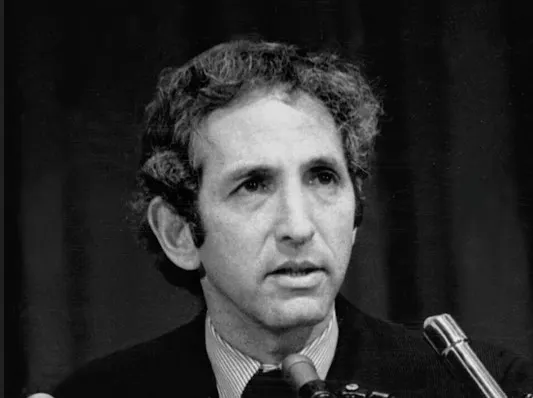
Daniel Ellsberg, co-author of The Pentagon Papers, speaking at a conference in 1972 – a year before the case against him was dropped. [Gotfryd, Bernard, photographer]