
t’s not about science at all, but a host of other things.
2024 was the 200th anniversary of what we now call climate science. It’s also marked the 40th anniversary of the founding of the George C. Marshall Institute, the first institution in the United States devoted to promoting scepticism about climate change.
In this article, we will look at how scientists established the link between greenhouse gas emissions and global warming, and why climate scepticism still exists, despite the scientific consensus now being all but complete.
It was in 1824 when the French physicist Joseph Fourier first postulated the idea of a greenhouse effect, to explain why the Earth was not a ball of ice. He realised that something in the atmosphere was trapping infrared radiation, but he did not know what it was.
The answer was provided in 1856 by the American scientist Eunice Foote, who showed that carbon dioxide was trapping the heat. The Irish physicist John Tyndale came to the same conclusion in 1861, and added that methane was also a greenhouse gas.
Then, in 1896, the Swedish scientist Svante Arrhenius calculated that a doubling of CO2 would result in a 4°C increase in global surface temperatures – a figure that is very close to modern day predictions. [Arrhenius was no fool. He won the Nobel Prize for Chemistry in 1903.]
Finally, in the 1930s the English meteorologist Guy Stewart Callendar gathered figures for CO2 and global temperatures from around the world over a 50 year period, and demonstrated that both were rising. He postulated that the rise in CO2 was causing the rise in temperatures, and that if this continued the planet would reach a tipping point where there would be runaway global warming.
Callendar’s view is now the scientific consensus on the topic. Indeed, so complete is that consensus that when researchers at Cornell University looked at 88,125 scientific papers published on the topic between 2012 and 2021, they found that only 0.1 percent were sceptical about anthropogenic global warming. [Anthropogenic global warming refers to the notion that human activity is heating up the planet.] In other words, the scientific consensus is now 99.9 percent!
This, of course, begs the question: why are there still climate deniers if there is no longer any scientific debate on the matter? Five key factors explain this seeming contradiction.
The first is psychological. Many people find the notion of climate change too frightening to accept. They would rather believe the 0.1 percent of scientists who still have doubts. Others see climate change as part of a new world they do not like or understand. This latter group (usually older men) lump it in with gay rights, women’s rights, land rights and other social changes which they perceive to be eroding their own place in society.
The second factor is economic. Some people see climate mitigation as threatening their lifestyle. They want to keep their cars, boats and overseas holidays, and they think that dealing with climate change will deprive them of these (or make them feel guilty about them). Other people fear the cost of dealing with the problem, thinking it will bankrupt the country or affect their livelihoods or superannuation. And, of course, the fossil fuel companies themselves see climate action as an existential threat to their business model. They are among the wealthiest corporations in the world, and have been prepared to spend huge amounts of money peddling disinformation about the nature and seriousness of a warming planet.
The third factor is social. People tend to be influenced by their peers. If their friends are climate sceptics, then the chances are they will be a sceptic too. Similarly, those who live in a media bubble (watching Fox News or reading the Murdoch press) only hear the views of sceptics, and therefore think that everyone thinks that way, and that those who disagree are stupid, deluded or mendacious.
The fourth factor is religious. Some believers feel that God would never allow humanity to destroy nature, so there is nothing to worry about. Others (especially in the United States) welcome global warming, as a way to bring about Armageddon and the Rapture.
The final factor is ideological. Some on the political right see climate activism as a left-wing issue, and because they hate the political left, they also reject the science of global warming. Then, of course, there are hardcore conspiracy theorists, who see climate science as a scam perpetrated by pseudo scientists who are simply in it for the money. (If you really want to make money, you don’t work as a climate scientist; you work in the fossil fuel industry.)
Hence, climate scepticism is not based on science at all, but on deep-seated views about the world. It is for this reason that it can’t be battled on scientific grounds alone, but instead requires an approach that takes into account the myriad factors driving it. Unfortunately, this is a much harder task than arguing chemistry, physics and biology.
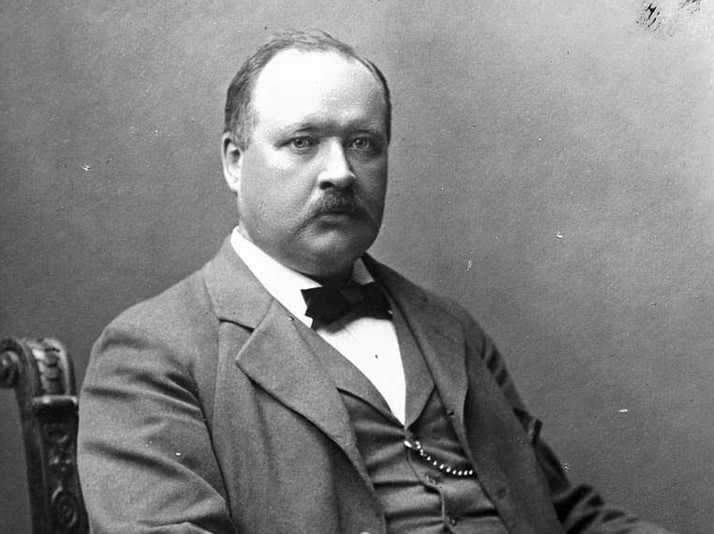
Swedish scientist Svante Arrhenius, who developed the first model of global warming in 1896.