
Yes, but it won’t be happening anytime soon.
Cement is one of the most important commodities on the planet, as it is the main ingredient in concrete (the others being stone and sand). It accounts for about 4.8 billion tonnes of CO2 emissions each year, or 8 percent of the global total. Unfortunately, it is particularly difficult to decarbonise and, like steel and aluminium, has no available substitute. Production is also rising by 2.5 percent annually across the world, so if we are to get global emissions down to a manageable level, we must find a way to decarbonise this industry.
Let’s start with the basics. Cement is made by heating limestone, clay and other materials in a kiln. CO2 is emitted when energy is produced to fire the kiln and when the limestone is heated within the kiln (a process known as calcination). For every tonne of cement produced, 0.92 tonnes of CO2 are released.
About 40 percent of these emissions come from the generation of heat. Kilns are usually fired using coal, gas or oil. Decarbonising this part of the process involves replacing these energy sources with ones that are less carbon-intensive. Such sources could include biomass, old tyres, sewage sludge and solid wastes. Doing this could reduce emissions by as much as 24 percent, but could not eliminate them completely. To make truly deep reductions, kilns would have to be fired using electricity, and that would require a complete transformation of the cement making process. Work is currently underway on this in Europe and the United States. The Mexican company CEMEX and its Finnish counterpart Coolbrook have developed a Roto Dynamic Heater, which operates with cleanly-generated electricity. This technology can reduce emissions by as much as 45 per cent, and is being installed at Adani’s Boyareddypalli cement plant in India.
The calcination process is even harder to decarbonise than the heating of kilns, as it means using something other than limestone. Some of that limestone can be replaced with coal fly ash and blast furnace slag, cutting emissions by as much as 20 percent. However, these substances can contain toxic heavy metals, and their use is restricted by environmental regulation.
Another way to reduce emissions is to use carbon capture and storage (CCS) technology, although this would be expensive. An interesting option would be to expose concrete to a mixture of CO2 and water, thus forming calcium carbonate. This process, known as accelerated carbonation, would allow the CO2 to be stored within the concrete itself over the long-term – a very neat solution to a serious problem.
Yet another way would be to add compounds (“admixtures”) that would strengthen the cement, so less of it were needed to produce concrete. It is estimated that this method could reduce carbon emissions by another 30 percent, and eventually by as much as 50 percent.
The problem is, all of these techniques are expensive, rendering low-emissions cement uncompetitive with its ‘dirty’ counterpart. One answer would be for companies to charge a premium for such cement, knowing that environmentally-conscious consumers would be willing to pay it. Another would be for governments to mandate that cement be made this way. This is what will happen in California, starting in 2045.
In the long-term, the solution will be to find products that can replace cement altogether. Already, such a polymer has been produced from a combination of waste plastics and soil contaminated with hydrocarbons and heavy metals. If this polymer could be produced at commercial rates, it would allow emissions to be reduced and dangerous waste to be disposed of simultaneously.
So how far advanced are we in the decarbonisation process?
One company that has set off down this path is the Swiss conglomerate Lafargeholcim, the largest producer of concrete in the world. It has lowered its carbon emissions by 25 percent since 1990 and is planning to reach net-zero emissions as soon as it can. Two other companies that have reduced their carbon footprint are China National Building Materials (the largest producer of cement in China) and CEMEX. The latter plans to reduce its carbon emissions by 35 percent by 2030.
Hence, it would be wrong to think that we cannot produce low-emissions cement. However, it would be equally wrong to think we are anywhere close to doing so commercially. This is one of the most difficult industries to decarbonise, and so will likely be one of the last ones we wind up tackling.
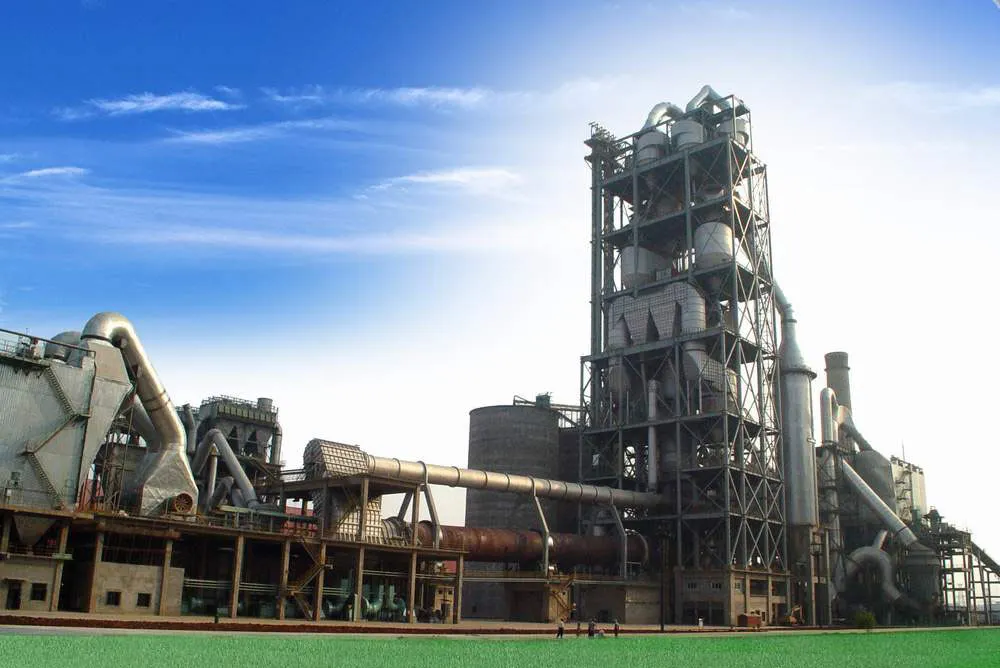
A cement plant, of the type we will need to completely transform.