
Can we really power the world with renewables?
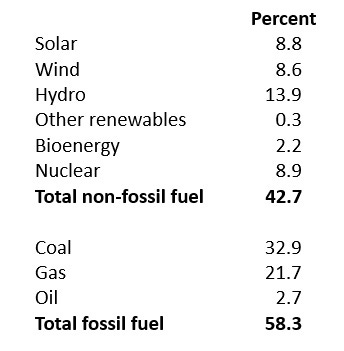
The rise of renewable energy has been relentless over the past few years. In 2025, wind, solar and hydro accounted for a third of global electricity generation. When nuclear and biofuels are included, the figure rises to 42.7 percent. Fossil fuels now account for just 58.3 percent of the total. This can be seen in the table below.
Solar and wind have been the major contributors to this rise. Between 2022 and 2025, 2,241 gigawatts of solar and 531 GW of wind were added to the global grid, bringing the total to 2,772 GW. As a percentage of global electricity generation, wind and solar are expeced to rise to almost 20 percent by the end of 2026. This increase is spectacular when you consider that they represented just 1 percent in 2005, 4 percent in 2015 and 15 percent in 2024. More impressive still is the fact that they passed nuclear energy in 2021, and each is expected to pass it in 2026. By 2033 each is also expected to have passed coal. This is partly due to the pace of the renewables rollout and partly because of the decline of coal.
The driving force behind all of this has been China. Between 2022 and 2025 it installed 899 GW of solar and 326 GW of wind, for a total of 1,125 GW.
But other nations have been active too. The EU added 190 GW of solar and 65 GW of wind over that same time period, making a total of 255 GW. The US added 185 GW of solar and 25 GW of wind, for a total of 210 GW. India added a total of 85 GW, while the nations of Latin America added another 70 GW.
So, with all of this happening, where will the world be in 2050, when global demand for electricity will have doubled? Well, even the most conservative estimates suggest the generating capacity of solar and wind will have increased eight-fold, taking each to 40 percent of global electricity generation. Some studies suggest this may happen as early as 2035. The remaining electricity will be provided by hydro, with gas as a residual. Thermal coal will have almost totally disappeared.
But why will global demand for electricity only double, when virtually everything will have to be electrified by mid-century? The reason is that electric appliances and vehicles use far less energy than fossil fuel-powered ones. For example, if we replaced all the world’s internal combustion engine (ICE) vehicles with EVs, we would only increase the demand for electricity by between 15 and 30 percent. So, by electrifying everything we can uncouple global production from the demand for energy, meaning output can rise while energy use actually falls. This means we really can power almost everything with wind, solar and battery storage.
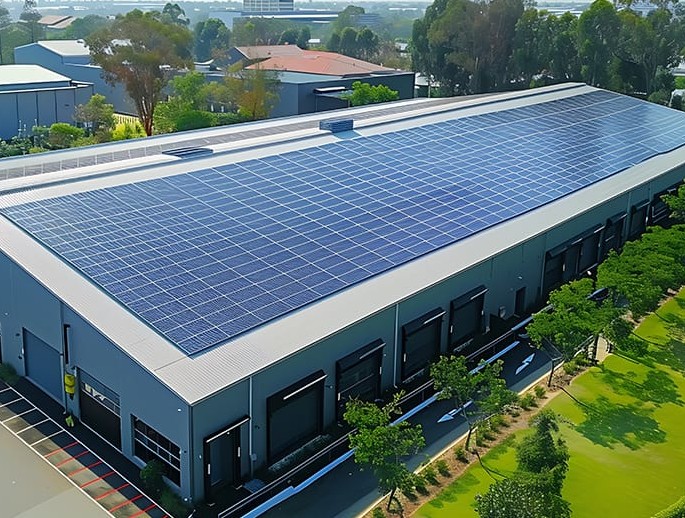
Solar panels on a warehouse roof.