
Where do our coal exports go, how are they used and what are their prospects in coming decades?
As with LNG, Australia is a major player in the international market for coal, being responsible for 34.9 percent of global exports. In 2024 we were the world’s leader by a comfortable margin. After us comes Indonesia (with 19 percent), then Russia (13.6 percent), the United States (8.9 percent), Mongolia (5.3 percent), Canada (4.4 percent), South Africa (3.9 percent) and Columbia (3.8 percent).
Coal is more complex to analyse than gas because it has two completely separate uses. Thermal coal is used to generate electricity, while metallurgical coal (also known as coking coal) is used to produce steel.
About 70 percent of the coal Australia mines is exported. 55 percent of those exports are thermal and 45 percent metallurgical. 30 percent of our exports go to Japan, 16 percent to China, 14 percent to India, 10 percent to South Korea, 8 percent to Taiwan and 6 percent to Vietnam. We will examine each of these nations in turn.
Japan gets 26.2 percent of its energy from coal, and 99.6 percent of that coal is imported. 65.5 percent of it comes from Australia, and 70 percent of that is used for energy generation. In fact, 28.3 percent of Japan’s electricity is produced using coal. Another 33 percent comes from gas, 42 percent of which also comes from Australia.
Japan’s dependence on coal has been exacerbated by the Fukushima nuclear disaster in 2011, which forced the country to close its reactors and replace them with reactivated coal-fired power plants. In the 14 years since, those reactors have gradually been reopened, and the government now plans to increase its dependence on nuclear power from its current level of 8.5 percent of the nation’s energy supply to around 20 percent by 2040. In the process, it plans to reduce its reliance on coal from 26.2 percent to 19 percent by 2030, then phase it out altogether by 2035. This will cut our coal exports substantially.
China is another big user of coal. It gets 55 percent of its energy from the ‘black stuff’ – 89 percent of which is sourced locally. The rest is imported, and 18 percent of those imports come from Australia. 90 percent of the coal we sell to China is thermal, with the other 10 percent metallurgical.
Though China is still heavily dependent upon coal, that dependence is declining. Last year, coal use fell by 3.4 percent, and it continued to decline in 2025, mainly because so much renewable energy is being added to the nation’s grid. At present, almost 50 gigawatts of solar and wind are being added every month, which is staggering, considering that Australia’s entire generating capacity (coal, gas, solar, wind and hydro) is not much greater than this.
Our next biggest customer is India, which gets 56 percent of its energy from coal. 77 percent of that coal is produced locally, with another 23 percent imported. 59 percent of those imports come from Australia – down from 81 percent in 2018. India’s electricity grid is still heavily dependent on coal, with 73.4 percent of its power generated this way. However, the government is planning to reduce this significantly, with clean energy expected reach 45 percent of total electricity supply by 2030. This will certainly reduce the demand for Australian exports.
After India comes South Korea. 98 percent of the coal Korea uses is imported, with 59 percent of it used in power generation and 41 percent used in the production of steel. 30 percent of its imports come from Australia.
Coal is currently responsible for 33 percent of the nation’s electricity generation, but this is expected to drop to 17.4 percent by 2030, as new nuclear reactors are brought online. In 2025 the government committed the nation to phasing coal out altogether by 2040. Then in April 2026 it pledged to step up the rollout of renewables, following the global oil crisis sparked by the attack on Iran. Again, Australia’s exports will be negatively impacted by this.
Finally, there is Vietnam. It gets 44 percent of its energy from coal, and a quarter of that comes from Australia. The reason for such a high dependence on coal is that the nation gets 63 percent of its electricity from this energy source.
So, what is the overall trend with regard to our coal exports? Basically, they have been flatlining for the past eight years and are set to plummet over the next two decades. The Commonwealth Treasury estimates that domestic production will fall by between 42 and 51 percent over the next ten years, mainly due to the closure of 11 of our 18 coal-fired power stations. These represent 76 percent of our coal-fired generating capacity. Exports will also fall over the next decade, then will nosedive after that. Domestic production is expected to fall by as much as 75 percent by 2050, and the fall may well be greater than that. [Note: These figures predate South Korea’s decision to phase out coal by 2040.]
So, whether people like it or not, coal is on the way out. As a nation, we can either sit around and wait for that to happen, and suffer the economic consequences, or plan for an orderly phase-out and develop replacement industries that will sustain us into the future. There are good environmental reasons for pursuing the latter course, but there are sound economic ones too.
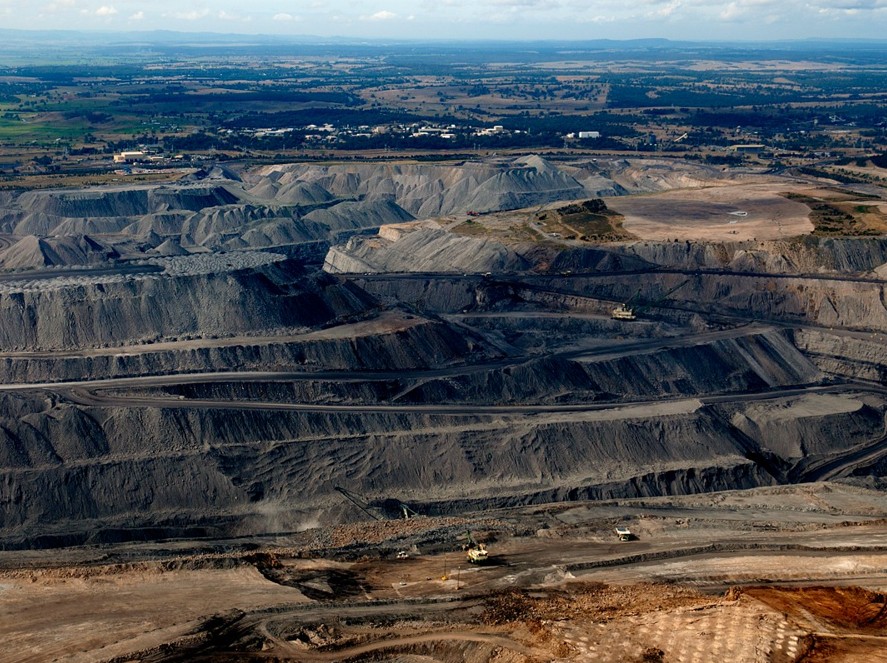
Open cut coal mining in Australia.